
Pest Management
Pests are any organism that causes harm, and in horticultural systems includes animal pests, weeds, and diseases which can damage or kill crop plants. Total elimination of pests is often impractical or expensive so scientists and farmers must determine what amount of pests or damage is acceptable. Keeping these pests and the damage they cause to an acceptable level is pest management.
The most effective method of controlling pests of any kind is usually to use multiple tactics which decrease the risk of harmful pest populations. By integrating these different management tactics, we ensure that pests are unable to adapt or avoid any single strategy, and we can use whatever approaches work best for our farming situation. Combining a variety of approaches for managing pests into a single system is called Integrated Pest Management (IPM). The pest management program at Virginia State University researches a variety of these pest management practices to provide information to growers and farmers in Virginia to help them build effective IPM programs.
Onion Maggot Research in Garlic
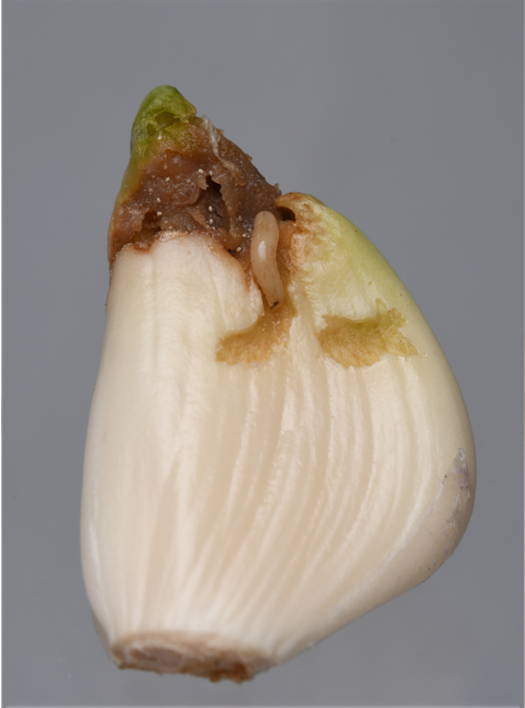
Onion maggots in garlic cloves
Garlic is grown by small farmers throughout the United States because it can be grown overwinter which allows rotation with summer grown crops, and it produces a high value on relatively small acreage. One of the most damaging insect pests of onions and garlic grown in the United States is onion maggot. The larvae of the onion maggot fly (Delia antiqua) burrow into the bulb of allium crops, killing onion plants and infesting garlic bulbs with maggots. Preliminary research done at Virginia State University’s Randolph Farm revealed that in 2024, 40% of garlic grown was infested with onion maggots.
Because the maggots grow inside the plant there are very few effective methods of controlling onion maggots for growers unwilling to use systemic insecticides. Ongoing research at VSU is working to identify varieties of garlic which may be less attractive to the onion maggot fly, and to identify planting practices which may decrease the infestation rate in Virginia grown garlic.
Weed Management in Ginger
Ginger is a high value crop that has been grown in the United States for centuries and has experienced a recent rise in interest nationwide because of increasing awareness of its medicinal and culinary uses. Virginia State University has been a leader in ginger research in recent years, exploring varieties which may perform well in our climate, and different production methods which may increase yields and quality.
Because of ginger’s long growing season, and relatively weak ability to compete with vigorously growing weeds, controlling and removing weeds is a large cost to farmers trying to grow ginger in Virginia. Ongoing research at Virginia State University is exploring different methods of controlling weed control: plastic and wood mulches, physical weed removal, and herbicides to determine which methods are potentially the most cost-effective for Virginia farmers.
These weed control methods not only prevent weeds with varying levels of success, they also alter the below-ground environment. Preliminary research at Virginia State University’s Randolph farm suggests that some weed control methods might increase the damage caused to ginger rhizomes by soil dwelling beetle larvae (wireworms). Research is ongoing to determine if this risk should alter weed control recommendations for Virginia growers.
Insect Pest Damage Thresholds in Virginia Ginger
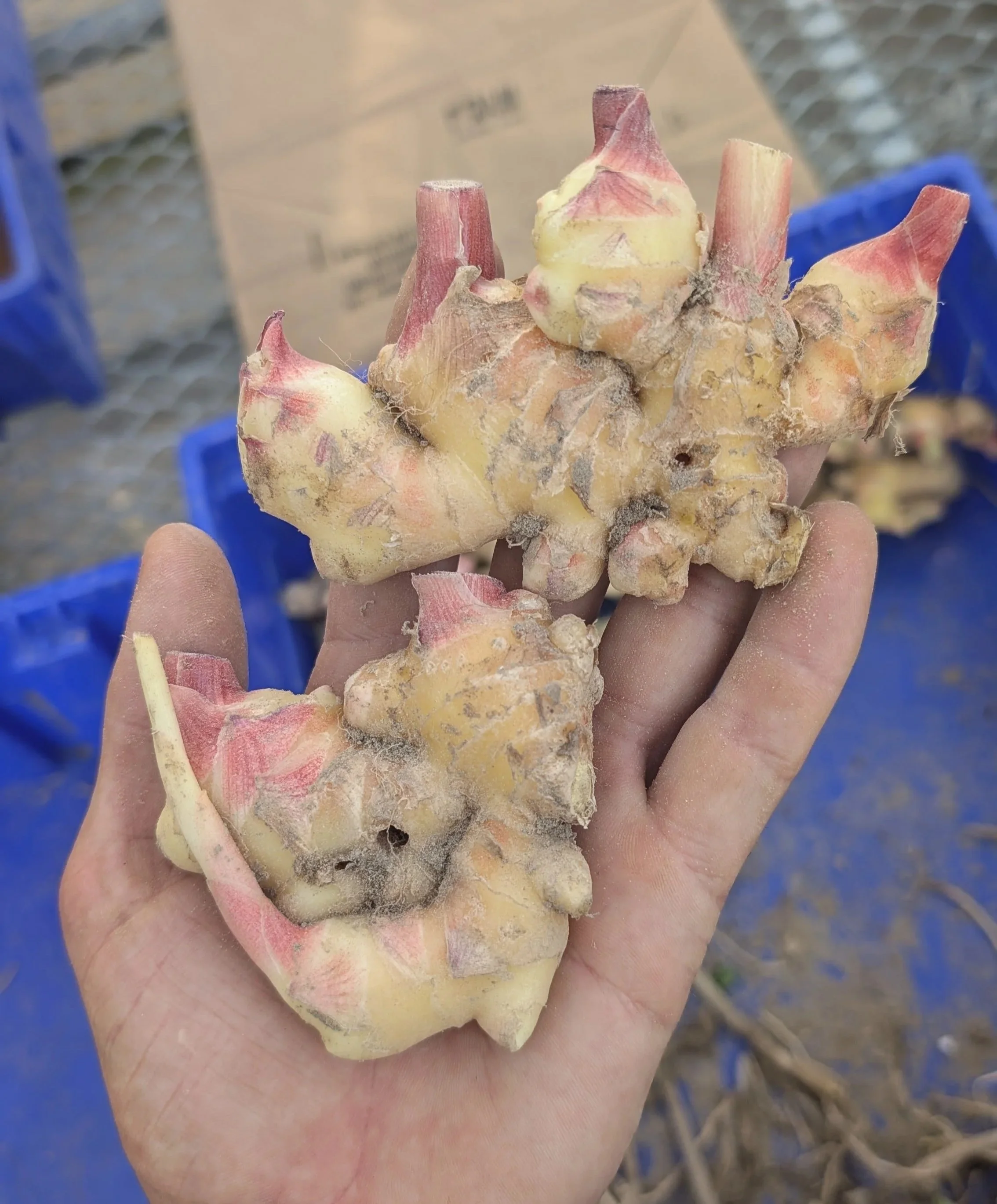
Ginger rhizome showing holes caused by insect pests
Some of the most commonly encountered insect pests in Virginia grown ginger are grasshoppers and caterpillars which feed on ginger leaves. Plants can tolerate a certain amount of leaf damage without affecting the yield of the ginger rhizome. Ongoing research at Virginia State University is working to understand what level of insect feeding damage ginger plants can handle before yield is affected. By comparing the potential loss in yield to the cost to control pests (for example, purchasing and applying an insecticide), researchers are hoping to determine the exact point at which it makes financial sense for ginger growers to apply pest control methods. These break even points are often referred to as action thresholds.
Further reading on Integrated Pest Management:
· https://www.epa.gov/safepestcontrol/integrated-pest-management-ipm-principles
· https://www.pubs.ext.vt.edu/ENTO/ENTO-365/ENTO-365.html
· https://ipmdata.ipmcenters.org/
Further reading on ginger production:
· https://ext.vt.edu/lawn-garden/Timely_Topics/Ginger.html
· https://www.pubs.ext.vt.edu/SPES/spes-706/spes-706-6.html
Further resources about growing garlic in Virginia:
· https://www.pubs.ext.vt.edu/SPES/spes-706/spes-706-11.html
COnnect
e-newsletter
Sign up to receive our weekly e-newsletter and event alerts directly to your inbox.
